From the Acting Principal
September 14, 2026 – Edition 12

Revealing Facts and Providing Context in Education
Much has been made in the media and in politics over the last couple of weeks about education in Australia, with most of the discussion focused on declining outcomes.
It’s worth looking at the results in context. Australia’s NAPLAN (National Assessment Program – Literacy and Numeracy) results have fallen in most areas, which is not what anyone would like to see.
To provide some context, here are graphs of Australia’s performance in Science, Reading and Mathematics in the OECD’s Programme for International Student Assessment (PISA).
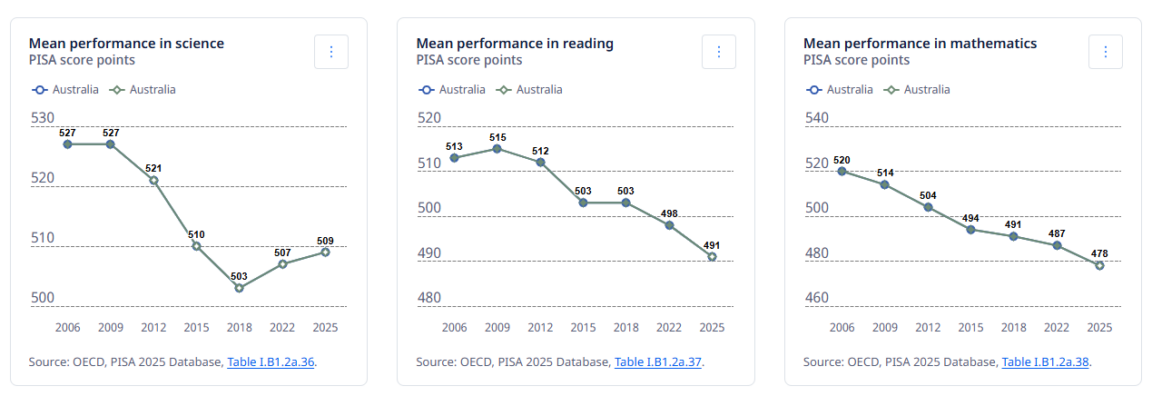
This is only part of the picture. Here is Australia’s performance in the same three areas compared to the OECD average.
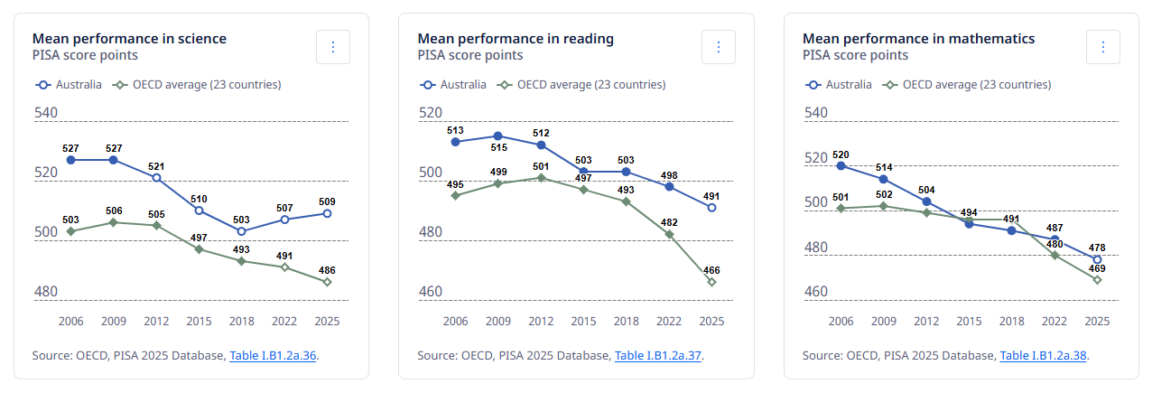
This shows that performance has fallen considerably across much of the world with Australia continuing to perform above the OECD average. Add to this that Victorian students outperform the national averages in most areas and (to be a bit parochial) Casey Grammar School students outperform state and national averages.
The picture is therefore more complex than a simple ‘education crisis’ narrative might suggest.
There are, of course, many questions which arise from this phenomenon:
- How do these standardised tests measure student performance?
- How do these tests compare with the curriculum or other assessments, such as VCE and IB?
- Are there social and cultural phenomena impacting learning (e.g. technology and the attention economy of social media)?
Our job is to maximise the learning of all students. Although our concept of education is much more broad, rich and deep than the narrow areas usually tested, we still need to critically examine how we can reverse the trend of declining results to build on the work already done to continually improve the academic culture of our school.
The other negative narrative circulating in politics and the media this last fortnight has been the contention that because education is too ‘feminine’, boys are being driven to the so called ‘manosphere’.
Again, blaming education generally, or curriculum specifically, for a worrying cultural phenomenon such as this is simplistic in the extreme.
For context, according to ACARA (Australian Curriculum, Assessment and Reporting Authority) data, 79% of primary school teachers and 62% of secondary school teachers in the independent school sector in Australia are female, so, yes, we have more female teachers than male.
This does not, however, mean that education or the curriculum is inherently ‘feminine’ or ‘overly feminine’.
The other claim discussed in this context was that programs such as Respectful Relationships, and others which seek to extend basic human dignity and respect to all students inclusively, are the problem.
We can agree that some young men feel lost in terms of their identity – forming one’s identity is part of the work of adolescence. Tackling stereotypes of male behaviour like not asking for help, not showing emotion and being aggressive is not ‘feminising’ the curriculum. It is helpful for young men to see that there are different ways of being a man, and male teaching and non-teaching staff can help in this area.
Helping young people develop healthy ideas about masculinity, relationships and respect benefits boys, girls and the broader school community.
Online influencers within what is called the ‘manosphere’ often target young men with simple answers and keys to what they define as success. Some of these messages are relatively benign and are proving attractive to many young men – be strong, don’t make excuses, work hard to achieve your goals and the like. There is nothing wrong, of course, with these ideas per se.
Making good choices, leading a disciplined life and working towards goals are good things. Unfortunately, the manosphere swiftly moves on to equate ostentatious displays of wealth, treating others as merely a means to an end, being in control and setting the rules for women and girls as markers of success.
Politicians are right to be concerned about the influence of the manosphere, but blaming schools for driving young men to it does not reflect the complexity of the influences shaping young men today.
Robert Jacob
Acting Principal